The battle of Barrosa took place on 5 March 1811 and was the result of a serious attempt by the garrison of Cadiz to lift a siege by the French on Cadiz. The siege began in February of 1810
at the end of the French conquest of Andalucia. It was clear from early on that the French would not be able to capture the city without first gaining control of the seas but by 1810 any chance of achieving that was over. Cadiz became a serious pain for the French as it drained them of resources, absorbing the full strength of Marshal Victor´s I Corps which greatly disabled Marshal Soult´s freedom of action in Andalucia.
By the beginning of 1811 Marshall Soult had launched an invasion on Estremadura which weakened the French garrison in Andalusia even more and left Marshal Victor very isolated. When the Spanish heard that Marshal Soul was off to Estremedura they could hardly believe their luck and decided to try and lift the siege. A combined British-Spanish army was landed on the coast south of Cadiz and they hoped that if this army appeared behind Marshal Victor´s lines he would be forced to take a large part of his own army out to the trenches to attempt to defeat it. This would allow the remaining troops in the garrison to attack and destroy the French siege lines. This somewhat hopeful plan would be put to the test at Barrosa at the south western tip of Marshal Victor´s lines.
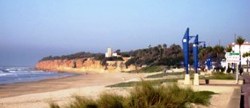
The battle of Barrosa took place on a triangle of land on the Spanish coast, immediately to the south of the Isla de Leon (Cadiz lies at the northern tip of this island). The northern tip of the battlefield was the peninsula of Bermeja, between the coast and the Almanza Creek. The southern end of the battlefield was marked by La Barrosa, at the foot of Barrosa Hill. This hill was topped by the watchtower of Barrosa. The third tip of the triangle was in the woods on the north east. The central part of the battlefield was filled with a pine wood, which the British troops would use for cover.
The British were a combined force from Cadiz, Gibraltar and Tarifa numbering some 5,196 men commanded by General Graham who was not a lover of our French cousins as he had witnessed the worst of the French Revolution while living in France with his invalid wife. The Spanish provided 8.000 men from Cadiz and 1,600 men from the Sierra Ronda. Their biggest weakness was their commander General La Peña. Not known for bravery, he watched from a safe distance of 3 miles as his fellow officer General Castaños suffered a heavy defeat at Tudela before leaving quietly without making any attempt to help. Just the sort of man you want on your sided in a fight. Facing this combined force was General Victor, who had 18,000 troops under his command, but was forced to fight with only 10,000 as the other 8,000 were engineers and other non combatant ranks or were deployed elsewhere on the Penninsula such as Medina Sidonia.
On the night of 4-5 March the newly landed army got lost on the road from Conil to Barossa and only in the morning discovered their mistake. They hurriedly cut across country to find the right location and it was then that they discovered the French blocking the path to Cadiz.
Although they had marched all night to get to the right area, the decision was made to attack but after heavy fighting the force was defeated. However, having built a bridge of boats across the Isla de Leon the Spanish General Zayas attacked the French from the rear, putting the allies in a very strong position. Running battles took place throughout the day which resulted in the British capturing the first French eagle of the Napoleonic wars and the French fleeing to the east. A decision was made by the French that if they were attacked on their siege lines they would retreat to Seville to re-group, abandoning Cadiz. This offered a once in a lifetime chance to route the French. The British wanted to pursue the French and force a breaking of the seige at Cadiz but General La Peña did not have the stomach for it and as a result the French resumed their siege on Cadiz which was not freed until 24 August 1812.
Sadly there was a great loss of life on all sides at the battle of Barrosa. Indeed General Graham was so disgusted by La Peña´s behaviour that he asked leave to rejoin Wellington in Portugal.
So the next time you pop down to Barrosa for a quick glass of wine and to watch the sun going down just remember that you are sitting on the site of a battle where Napoleon lost his first eagle.